
Inflation does not need to reduce the number shown in my savings account to make me poorer. If prices rise while my balance barely moves, that money buys less each year.
My response is deliberately boring. I cover essential costs, keep an emergency reserve, clear expensive debt, contribute to Pillar 3a every month and invest additional money for the long term. I am not trying to predict the next market winner.
Affiliate disclosure: This article contains referral links and a Finpension referral code. Expat Money may receive a benefit when you register through them. This does not increase the price you pay. Referral offers and eligibility conditions can change, so please verify the latest terms before registering.
My order of priorities
- Rent and essential living costs
- Basic health insurance
- Taxes and bills
- Full payment of credit-card balances
- Emergency savings
- Pillar 3a
- Additional investing
Second-pillar and third-pillar basics
Switzerland’s retirement system rests on three pillars: state pension (first pillar), occupational pension through your employer (second pillar), and voluntary private pension savings (third pillar). Newcomers usually meet the first two automatically through payroll and only discover the third by choice.
Second pillar (BVG/LPP)
If you earn above a minimum threshold, your employer is legally required to enrol you in an occupational pension fund, with contributions split between you and your employer and deducted automatically from your salary.
Third pillar (Pillar 3a)
This is a voluntary, individual retirement account with an annual contribution cap, and contributions are typically deductible from your taxable income up to that cap, one of the more reliable tax-saving moves available to residents. The rest of this article is my own personal approach to using it.
Pillar 3a is not automatically an investment
A Pillar 3a account is a legal retirement structure, not a single type of investment. A savings-based account generally holds cash and pays interest. A securities-based solution can invest in funds containing shares and other assets.
Cash may be suitable when I expect to need the money relatively soon, but low interest can leave it losing purchasing power after inflation. Equities offer more potential for long-term growth, but they can fall sharply and remain below previous highs for years. A high-equity portfolio requires a long horizon and the ability to tolerate losses without selling in panic.
How much I can contribute in 2026
For an employee affiliated with an occupational pension fund, the official 2026 Pillar 3a maximum is CHF 7,258. Dividing that by 12 gives CHF 604.83, so I plan around approximately CHF 605 per month.
Someone in gainful employment without an occupational pension can contribute up to 20% of annual earned income, subject to the 2026 maximum of CHF 36,288. Eligibility matters. I would confirm my pension status before relying on either limit.
My pay-yourself-first system
I automate the Pillar 3a transfer shortly after salary arrives. The sequence is simple:
Salary received
↓
Rent and essential expenses covered
↓
Basic health insurance paid
↓
Credit-card balance cleared in full
↓
Monthly Pillar 3a contribution
↓
Additional ETF investing
↓
Optional active trading with genuinely disposable capital
Investing while carrying expensive credit-card debt is generally counterproductive. The interest charged on that debt can be much more certain than any return I hope to earn from markets.
Why I prioritise Pillar 3a
Pillar 3a gives me a disciplined retirement structure and may reduce taxable income in the contribution year. The actual tax effect depends on income, canton, municipality and household circumstances. Withdrawals are taxed separately, so I do not treat the initial deduction as free money.
Restricted access also reduces the temptation to interrupt long-term compounding. Within a securities-based solution, I can choose diversified equity exposure and keep fees under review. Those characteristics can help my long-term purchasing power, but Pillar 3a itself does not guarantee protection from inflation.
My Finpension strategy
- UBS World equities excluding Switzerland: 57%
- UBS USA equities: 22%
- UBS Emerging Markets equities: 10%
- UBS Global Small Cap equities: 10%
- Total equities: approximately 99%
This is an aggressive personal allocation. The global fund already contains US companies, so the separate USA allocation creates an intentional US overweight. Emerging markets and small companies add different sources of growth, but also additional volatility. Someone approaching retirement or expecting an eligible withdrawal may need substantially less equity exposure.
My investment return so far
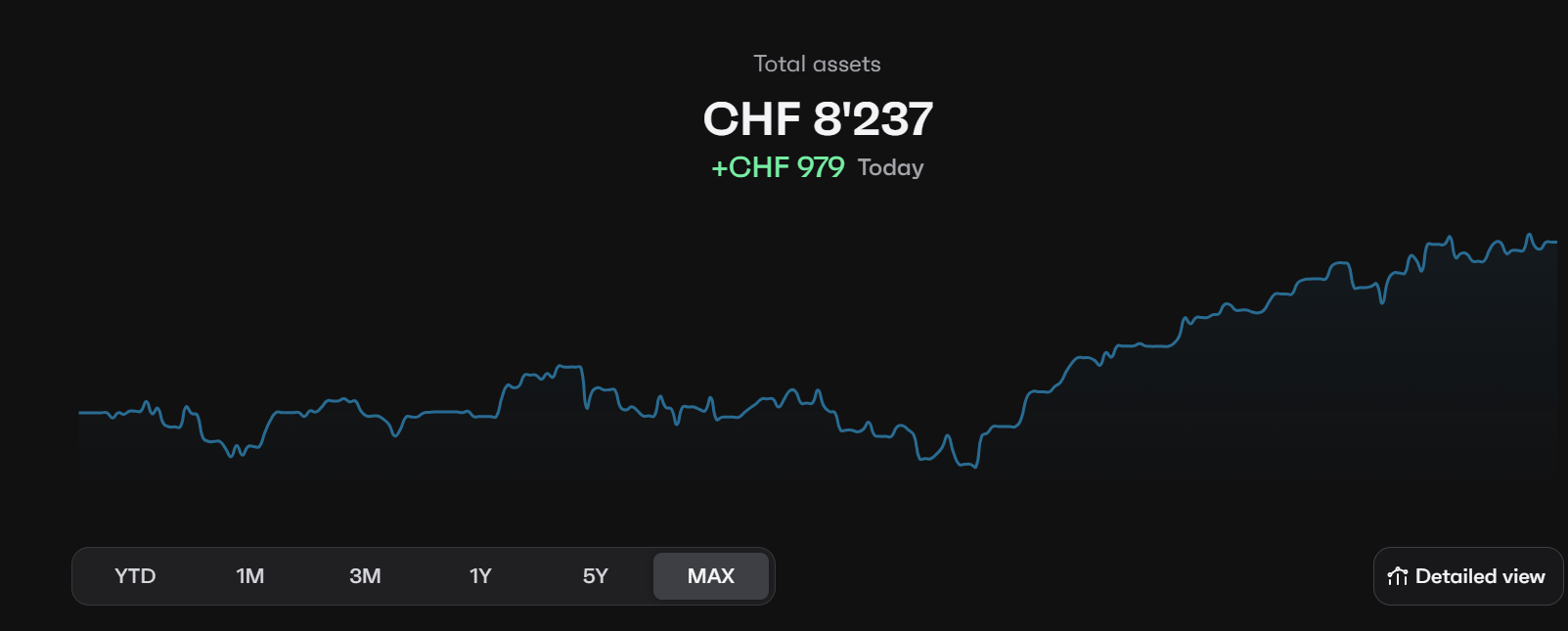
My account has shown an annualised return of approximately 13% so far. That result reflects a specific portfolio and market period. It is not a return I expect or assume will repeat.
Future returns may be lower or negative, and equity markets can remain below previous highs for extended periods. My goal is to stay ahead of inflation after costs over a long horizon, not to produce a spectacular number each year. A screenshot showing “+CHF 979 Today” could include a contribution, so I do not describe it as investment profit without confirmation from the platform.
Finpension referral offer
The current official terms require the code to be entered within 24 hours of registration. The new customer must then deposit or transfer at least CHF 1,000 within 12 months. Once both conditions are met, each person receives a CHF 25 credit that is offset against applicable fees.
Finpension referral code
UX7TT9The code remains visible if copying is unavailable.
Referral terms can change. Check the current conditions during registration.
What I do after maxing out Pillar 3a
After reaching the annual Pillar 3a limit, I invest additional disposable money through a normal brokerage account. Pillar 3a offers a tax-advantaged but restricted structure. A brokerage account has no Pillar 3a contribution ceiling and is more liquid, but contributions do not receive the same Pillar 3a deduction.
I use Interactive Brokers for long-term investing and a smaller amount of swing trading. Active trading is optional and is not the core of my wealth-building plan.
A simple ETF approach
Someone who does not want to analyse individual companies does not need to become a trader. A broad-market ETF may be a simpler starting point, provided the investor understands the risks and has a sufficiently long time horizon.
Global equity ETFs spread exposure across many companies and countries. S&P 500 funds focus on large US companies. Nasdaq-100 funds are relatively concentrated and heavily influenced by large technology-related businesses, so I would not treat them as automatically safe or fully diversified.
GameStop, Robinhood and broker risk
The January 2021 GameStop episode showed that market access involves more than share-price risk. Several retail brokers temporarily restricted certain activity as volatility, clearing deposits and collateral requirements increased. Investors can face market, liquidity and broker-operational risks, as well as margin changes and temporary trading restrictions.
I do not assume Interactive Brokers, or any broker, can never restrict trading. A broker’s legal obligations, risk controls and clearing arrangements can affect what happens during exceptional conditions.
What account protection really means
The US Securities and Exchange Commission is a regulator. It does not guarantee my returns or prevent investments from falling. SIPC protection is also not insurance against market losses. For accounts held at a SIPC-member broker, it deals with missing cash and securities if the broker fails, subject to its rules and limits.
Interactive Brokers operates through several legal entities. The protection framework depends on the entity named in my agreement and statements. Interactive Brokers LLC describes SIPC coverage up to USD 500,000, including a USD 250,000 cash sublimit, but I should not assume those exact arrangements apply unless Interactive Brokers LLC actually carries my account. Swiss residents should verify their account entity and the current compensation framework directly.
The US day-trading rule has not disappeared yet
FINRA proposed replacing its pattern day trader provisions with new intraday margin standards. As of this article’s publication date, that is a proposal rather than an effective replacement. The current FINRA interpretation still applies a USD 25,000 minimum equity requirement to pattern day traders in affected margin accounts.
The issue mainly concerns frequent same-day opening and closing of positions. Swing trading, where a position remains open overnight, is different. Broker systems and internal risk rules may also be stricter than the regulatory minimum, so I check the rules applying to my account rather than relying on headlines.
How Wise fits into my workflow
I may receive or hold CHF in Wise and use supported bank-transfer functionality to send funds to the bank details supplied by Interactive Brokers. I convert currencies only when necessary and review the fee, exchange rate and expected recipient amount before confirming. My separate Wise transfer review explains how I compare the total cost rather than the headline fee alone.
Wise is not automatically the cheapest route. A direct CHF transfer from a Swiss bank may sometimes be simpler or less expensive. The account name, reference and funding instructions must match the details shown in my brokerage account.
An illustrative monthly plan
| Allocation | Illustrative amount |
|---|---|
| Pillar 3a contribution | Approximately CHF 605 |
| Additional ETF investment | CHF 500 |
| Total monthly investing | Approximately CHF 1,105 |
CHF 50 invested consistently is more useful than an unrealistic CHF 1,000 target that is abandoned after three months.
Conclusion
My approach has no secret indicator and does not require me to identify the next market winner or chase crypto-style returns. It depends on consistent contributions, diversification, low fees, patience and a long time horizon.
It is not exciting. That is exactly why it works for me.
Sources
- Federal Social Insurance Office: Pillar 3a contributions
- Finpension: referral conditions
- FINRA: current Rule 4210 interpretations
- FINRA: proposed intraday margin standards
- SEC staff report on early 2021 market structure
- SIPC: what protection covers
- Interactive Brokers LLC: client protection
- Wise: sending money from an account